Demystifying the Digital Design Interview
The Missing Guide for Practical RTL and FPGA Interview Preparation
200+ embedded interview questions. Concept-first structure. Real engineering insight from 20 years in the industry — not recycled textbook content.
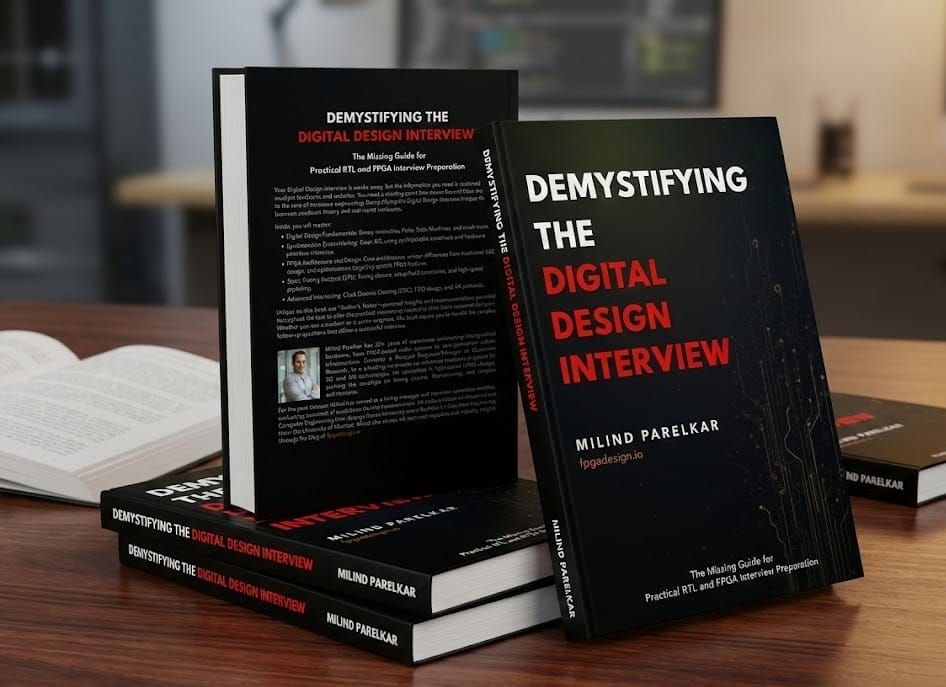
Most digital design interview prep material falls into one of two traps: it’s either a dense textbook with no interview focus, or a shallow Q&A list that collapses the moment an interviewer asks a follow-up. This book is neither.
Each topic is built up as a cohesive narrative — you develop genuine competency first, then validate it with the 200+ questions embedded throughout. The result is the kind of understanding that holds up in a real whiteboarding session, not just a rehearsed answer that falls apart under pressure.
It also includes a dedicated chapter on FPGA architecture — a gap that almost every other prep resource ignores entirely.
Who Is This Book For
Built for engineers at every stage
New & Early-Career Engineers
Close the gap between what you learned in school and what companies actually test for in RTL and FPGA interviews.
Senior Engineers
Targeted refresh on advanced topics — CDC, AXI, STA, FPGA architecture — before stepping into a senior or staff-level role.
Career Switchers
Moving from software or verification into hardware design? Build a solid RTL foundation without wading through an entire textbook.
What Makes It Different
Designed around how interviews actually work
Context-First Learning
Topics are covered as a cohesive narrative, not a random Q&A list. You build competency first — the questions follow to validate it. That’s the order that sticks.
The “Why” Over the “What”
Every design choice is explained in terms of its impact on synthesis, area, and timing. That’s what separates a candidate who memorized an answer from one who understands the tradeoff.
FPGA Architecture — a Dedicated Chapter
CLBs, LUTs, BRAM, URAM, clocking resources, SRLs. Most prep books skip this entirely. If you’re interviewing for FPGA roles, this chapter alone is worth it.
Author’s Notes Throughout
Inline pro-tips and design critiques drawn from 20 years of industry experience. The kind of context you’d only get from someone who’s been on both sides of the interview table.
Inside the Book
Table of Contents
Chapter 1
Digital Design Fundamentals
- ·Number systems & binary arithmetic
- ·Fixed-point representation
- ·Flip-flops vs. latches
- ·Finite state machines (Mealy & Moore)
- ·Endianness & memory mapping
Chapter 2
SystemVerilog for Design
- ·Blocking vs. non-blocking assignments
- ·always_comb / always_ff usage
- ·Interfaces & modports
- ·Avoiding inadvertent latches
- ·Parameterized designs & generate
Chapter 3
FPGA Architecture & Core Concepts
- ·CLBs, LUTs, SRLs
- ·BRAM, URAM & memory primitives
- ·Clocking resources & clock enables
- ·Synthesis directives & ILA
- ·FPGA vs. ASIC vs. microcontroller
Chapter 4
Static Timing Analysis & Timing Closure
- ·Setup/hold times & critical paths
- ·XDC clock & I/O constraints
- ·Pipelining, retiming & high fanout
- ·Timing exceptions & Pblocks
- ·SLR crossings
Chapter 5
Advanced Hardware Topics
- ·AXI protocol
- ·Clock domain crossing (CDC)
- ·Metastability & synchronizers
- ·FIFO design
- ·Tri-state buffers & static hazards
Chapter 6
Practical RTL Design Questions
- ·Pulse generators & clock dividers
- ·Barrel shifters
- ·ROM-based multipliers
- ·Ripple carry adders
- ·Fixed-priority & round-robin arbiters

About the Author
Milind Parelkar
Principal Engineer & Manager · Qualcomm · 20 years in RTL & FPGA design
Milind has spent two decades designing, reviewing, and shipping RTL and FPGA systems at Qualcomm. He has interviewed hundreds of candidates across all levels — from new grads to senior engineers — and built this book around the patterns he’s seen separate strong candidates from unprepared ones. He is the founder of fpgadesign.io.
Where to Buy
Available in paperback, hardcover, and Kindle e-book. Choose the retailer and format that works best for you.
🇺🇸 United States
🇮🇳 India
All paperback editions in India are black & white. For a full-color copy, the hardcover on Amazon India is the one to get.
🌍 Europe, Australia & Rest of World
This link automatically routes you to your local Amazon storefront — UK, Germany, France, Japan, Australia, Canada, and more.