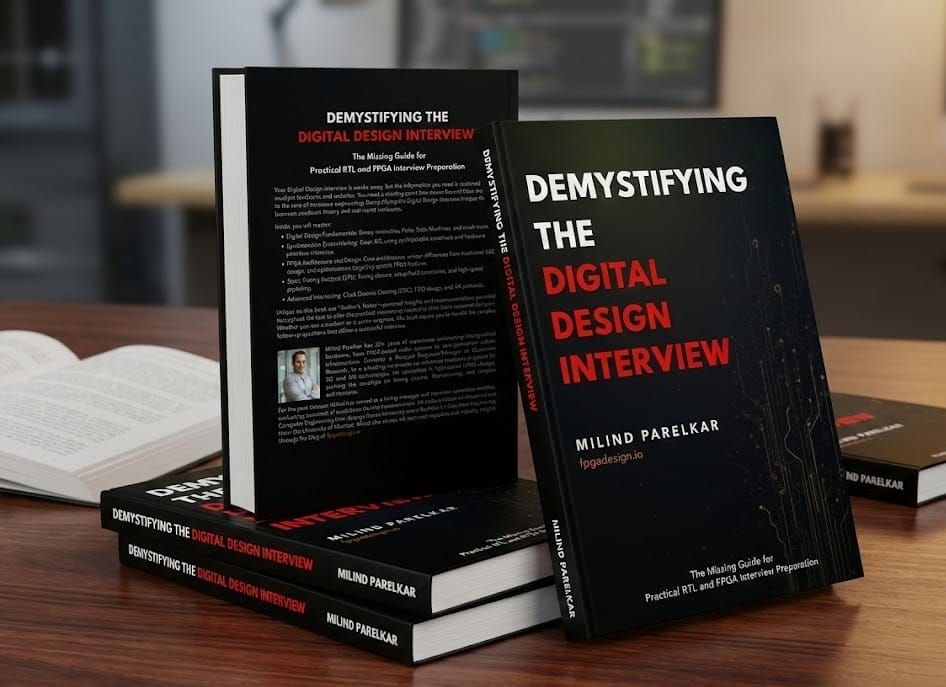
Demystifying the Digital Design Interview

The Missing Guide for Practical RTL and FPGA Interview Preparation

Order Now

"Demystifying the Digital Design Interview" bridges the gap between academia and real-world engineering. While the fundamentals apply to all logic roles, this guide includes a dedicated chapter on FPGA architecture—critical knowledge rarely found in typical prep books.

With 200+ targeted interview questions embedded throughout the text, you will build the technical competency required to navigate complex follow-up questions and professional whiteboarding sessions.

Who Is This Book For?
This book is designed for Aspiring Engineers looking to close the "academic disconnect" with practical design principles, Seasoned Professionals needing a targeted refresher on advanced topics for senior roles, and Career Switchers from software or verification seeking a foundational mastery of hardware design principles.

How Is This Book Different?

  • Context-First Learning: Topics are covered as a cohesive narrative rather than a random Q&A list. You gain competency first; questions follow to validate it.
  • The "Why" Over the "What": We explain how design choices impact synthesis, area, and timing in professional production environments.
  • Strategic Insights (Author’s Notes): Benefit from "pro-tips" and design critiques earned from 20 years in the industry at companies like Qualcomm.

How To Use This Book?

  • Targeted Review: Use the detailed Table of Contents or the comprehensive keyword index to navigate directly to specific technical domains.
  • Active Learning: Validate your knowledge in real-time with technical questions embedded in every chapter.
  • Final Polish: Use the design problems and answer hints in the appendix to simulate a live technical discussion and sharpen your problem-solving speed.

📋Table of Contents


1. 🧱 Digital Design Fundamentals

  • Number Systems & Binary Arithmetic: Dive into bit-growth, fixed-point representation, and handling truncation or saturation.
  • Endianness: Understand byte order in memory mapping and data transfers.
  • Memory & State Elements: Explore the core differences between Flip-Flops and Latches.
  • Finite State Machines (FSMs): A comprehensive look at Mealy and Moore machines.

2. 💻 SystemVerilog Mastery

  • Syntax & Semantics: Master vector initialization, case sensitivity, and avoid implicit net declarations.
  • Operators & Assignments: Navigate logical vs. bitwise inversion and blocking vs. non-blocking assignment statements.
  • Advanced Constructs: Maximize the use of specialized always blocks, generate statements, and parameterized bitslicing.
  • Data Structures: Understand packed vs. unpacked arrays, Modports, and robust Interface mapping.
  • Robust Coding: Learn strategies for avoiding inadvertent latches and architecting solid FSMs in SystemVerilog.

3. 🚀 FPGA Design Concepts

  • The Hardware Landscape: A comparative analysis of Microcontrollers, FPGAs, and ASICs.
  • Architecture Essentials: Explore core FPGA architecture, look-up table-based shift registers (SRLs), and reset usage.
  • Memory & Storage: Utilize Xilinx FPGA memory primitives and tackle advanced topics in FPGA memories.
  • Clocking & Power: Best practices for clocking elements, clock enables, and ASIC-style clock gating in FPGAs.
  • Implementation: Guide the toolchain with Synthesis Directives and Attributes, and debug on-chip with the Integrated Logic Analyzer (ILA).

4. ⏱️ Static Timing Analysis (STA) & Timing Closure

  • Constraints: Master location and clock constraints to guide the synthesizer.
  • Timing Fundamentals: Deep dive into I/O timing, setup/hold times, critical paths, and understanding levels of logic.
  • Optimization Techniques: Solve common timing failures through pipelining, retiming, and managing high fanout nets.
  • Advanced Control: Use Pblocks for floorplanning, define timing exceptions, and handle SLR crossings effectively.

5. 🔬 Advanced Hardware Topics

  • Interfaces & Protocols: Master handshaking protocols, Source Synchronous Interfaces, and the AXI Protocol.
  • Clock Domain Crossing (CDC): Deal with metastability and design safe Single-Bit and Multi-Bit CDC scenarios.
  • System Design: Understand conceptual topics in FIFO design, CPLDs, Tri-State Buffers, and Static Hazards.

6. 🛠️ Practical RTL Design Questions

  • Core Components: Build pulse generators, clock dividers, and barrel shifters.
  • Arithmetic & Logic: Design ROM-based multipliers, ripple carry adders, and parity detectors.
  • System Control: Implement fixed-priority, round-robin, and rotating-priority arbiters.